![[personal profile]](https://www.dreamwidth.org/img/silk/identity/user.png)
Yesterday I had booked myself for a lesson in beetroot gnocchi at Tricolore, that wondrous place with the croissants and incredibly photogenic (tasty too) bread .

Once cooked, the gnocchi were sautéed with turbot and leeks. And eaten with much satisfaction.
The class was fun, there were only five of us students and the two chefs, so we had plenty of room around the cooking island and on the marble countertop.
It was a short class (and hour) and therefore we had no time to cook, peel and rice the potatoes, nor to cook and purée the beetroots.
They were all nicely prepared for us:

The proportion given for one person is 250 g of potatoes (waxy preferably) and a medium sized beetroot. The potatoes are cooked in simmering water for ages (an hour and a half from cold water or so we were told). The beetroot covered in salt and cooked for 2 hours in the oven at 200C.
Our first assignment was to thinly dice the turbot and leek:

A fillet and half a leek per person being the given proportion.

Then we went on to mix the potatoes, beetroot and one egg yolk on the marble counter top. With bare hands. Messy business, that, and I could not grab my camera to take pictures for the longest time.
Once all three are well mixed (but just so - no over mixing that would bring out the starch from the potatoes) you add the flour, little by little and as little as possible to obtain a ball of dough that does not stick to your hands anymore (75g of 00 flour, which is cake flour - it contains less gluten). No salt.
Fun. I had not played with clay or Play-Doh for ages.
Then the dough is apportioned and rolled out in cylinders about a finger thick and cut again in bits 1cm to 2cm - the size does not really matter too much as long as the pieces are regular.
At that point in time I was able to finally wash my hands - with difficulty - and grab my camera again:

This done, we put the water on the furnace, so it would boil while we would tackle the sauce.
Which is not much of a sauce really, possibly condiment would be a better term.
It starts by warming up some olive oil and gently frying the slips of leek, adding a little white wine and when the alcohol has evaporated the turbot.

Stir well until cooked - a few minutes if that. Set aside.
Add salt to the boiling water and then, plop all the gnocchi in.
When they are all coming up to the surface, place the pan with the leek-turbot once again on the burner (on high) and throw in the drained gnocchi in. With a spatula, give them a gentle folding motion stir, so they are all evenly coated in crumbs of turbot and leek ribbons. Taste. Add salt as necessary. Pepper if you like. Just a filet of oil.
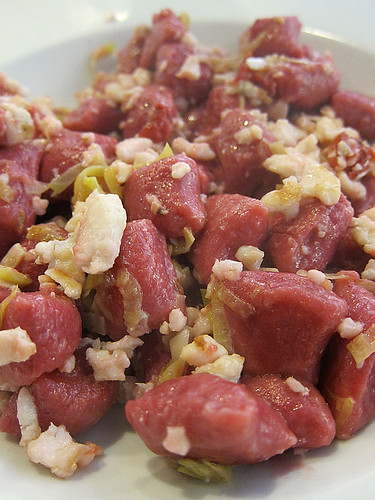
Enjoy. That's what we did - and that was quite a lot to enjoy too as I had managed to prepare the full portion of gnocchi.
Much fun and information from and loads of gratitude to the chefs:

(Lorenzo and Veronica, I believe - ? - I am terrible with names)
I shall certainly come back for more.
The only drawback was the speed of if all, in particular the lack of time left to enjoy the food we had prepared, as there was another class waiting outside.
The move of the Saturday lunch time class to Sunday lunch time slot might allow for a more relaxed atmosphere, in particular if both classes can be combined.
I am reliably told that the week days evening classes are much more relaxed.
Once cooked, the gnocchi were sautéed with turbot and leeks. And eaten with much satisfaction.
The class was fun, there were only five of us students and the two chefs, so we had plenty of room around the cooking island and on the marble countertop.
It was a short class (and hour) and therefore we had no time to cook, peel and rice the potatoes, nor to cook and purée the beetroots.
They were all nicely prepared for us:
The proportion given for one person is 250 g of potatoes (waxy preferably) and a medium sized beetroot. The potatoes are cooked in simmering water for ages (an hour and a half from cold water or so we were told). The beetroot covered in salt and cooked for 2 hours in the oven at 200C.
Our first assignment was to thinly dice the turbot and leek:
A fillet and half a leek per person being the given proportion.
Then we went on to mix the potatoes, beetroot and one egg yolk on the marble counter top. With bare hands. Messy business, that, and I could not grab my camera to take pictures for the longest time.
Once all three are well mixed (but just so - no over mixing that would bring out the starch from the potatoes) you add the flour, little by little and as little as possible to obtain a ball of dough that does not stick to your hands anymore (75g of 00 flour, which is cake flour - it contains less gluten). No salt.
Fun. I had not played with clay or Play-Doh for ages.
Then the dough is apportioned and rolled out in cylinders about a finger thick and cut again in bits 1cm to 2cm - the size does not really matter too much as long as the pieces are regular.
At that point in time I was able to finally wash my hands - with difficulty - and grab my camera again:
This done, we put the water on the furnace, so it would boil while we would tackle the sauce.
Which is not much of a sauce really, possibly condiment would be a better term.
It starts by warming up some olive oil and gently frying the slips of leek, adding a little white wine and when the alcohol has evaporated the turbot.
Stir well until cooked - a few minutes if that. Set aside.
Add salt to the boiling water and then, plop all the gnocchi in.
When they are all coming up to the surface, place the pan with the leek-turbot once again on the burner (on high) and throw in the drained gnocchi in. With a spatula, give them a gentle folding motion stir, so they are all evenly coated in crumbs of turbot and leek ribbons. Taste. Add salt as necessary. Pepper if you like. Just a filet of oil.
Enjoy. That's what we did - and that was quite a lot to enjoy too as I had managed to prepare the full portion of gnocchi.
Much fun and information from and loads of gratitude to the chefs:
(Lorenzo and Veronica, I believe - ? - I am terrible with names)
I shall certainly come back for more.
The only drawback was the speed of if all, in particular the lack of time left to enjoy the food we had prepared, as there was another class waiting outside.
The move of the Saturday lunch time class to Sunday lunch time slot might allow for a more relaxed atmosphere, in particular if both classes can be combined.
I am reliably told that the week days evening classes are much more relaxed.
Tags: