![[personal profile]](https://www.dreamwidth.org/img/silk/identity/user.png)
Yesterday, it was la Festa della Repubblica and we had a day off, so off I went to visit two places that are still fairly secret in Rome: La Città dell' Acqua and the Chapel Bissarione. Today, let's have a look at the Chapel, which is hidden in the church of Santi Apostoli.
Here's a view of the inside of the Chapel:

I am on the first floor looking down on the rest of the group on the ground floor and as you can see, this Chapel is barely bigger than Anne Frank's famed cupboard (although it does have more ceiling room).
The burial chapel was made for the cardinal Bessarione and was covered in affreschi by Antoniazzo Romano and Melozzo da Forli, both under the influence of Piero della Francesca, in the period from 1464 to 1468.
They apparently consisted of a lower tier with Madonna and Child in the middle between portaits of Saint John the Baptists and Saint Eugenia, an upper tier with two scenes recalling miracles of Saint Michael and a ceiling showing a triumphant Christ amidst the nine armies of angels.
However, in the course of the later centuries, the chapel - and therefore the artworks - suffered greatly.
First a series of floods damaged the lower tier and the ground floor was raised and a layer of plaster applied to the paintings (in 1545) - there was also the slight matter of the sack of Rome by the lansquenets - then an altar to Saint Antony was built in front of the paintings (in 1550) and to finish, a whole new monumental chapel was built in front of it in the early 18th Century, blocking it completely.
So the Chapel Bissarione ceased to exist in the mind of people, with just a few traces in a handful of texts.
Then in 1959, an architect - who was doing some work in the palace next door (Palazzo Colonna) - found that some of the walls between the room he was in and the church were returning an "empty" sound when tapped. The wall was pierced and the secret discovered.
Extensive restauration work took place from 1989 to 2005 and so it is that the chapel is only recently opened to the public (and very little at a time as the space is reduced). And thus still a well hidden spot in overloaded Roma.
The ceiling would be in good shape if it wasn't for the fact that a good half of it has been eaten up by the construction of the Chapel Odeschalchi:

In this picture, you can see the bottom of the Christ's coat:
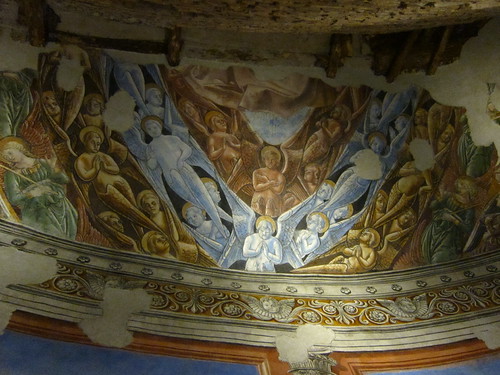
So you can imagine how much is actually missing...
The lower tier is showing replacement paintings of Saint Eugenia and Saint Claudia, whose remains were already in the church since the 9th Century.

The paintings aren't terribly good (they date from between the end of 16th to the beginning of 17th Century) but the Madonna and child is a copy of the original painted by Antoniazzo:

The upper tier is the most interesting of all because there is a real influence of the Cardinal's personality and history in it.
Both panels are dedicated to Saint Michael, who appears in the guise of a bull.
The left hand scene shows a miracle associated with the city of Siponto del Gargano (hired hunters unable to kill a bull, their arrows being returned towards them):

The art of Melozzo da Forli (and the influence of Piero della Francesca) is clearly shown on the face of this hunter:

As on the faces of various characters in the right hand panel:
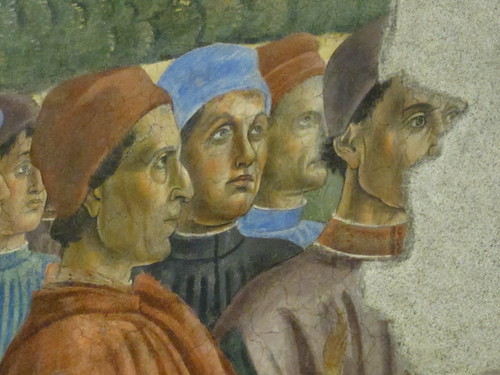
Here, Francesco Maria De la Rovere (future Sixt IV) and Giuliano De La Rovere (future Jules II), for instance, whom Bessarione wanted to back a crusade to liberate Constantinoples.
Bessarione was born in Trebizond, in Christian Turkey in 1403, and all his life fought to bring together the two diverging catholic religions together and to free Constatinoples from the Ottomans (who held it since 1453).

When the two popes could not back him, he went ahead and approach the king of France, Louis XI, who is said to be represented on this painting as Saint Aubert, the man painted in bishopric clothes of gold here above.
But the king could not afford a crusade any more than the popes could.
Still, the painting shows the founding of Mont Saint Michel, with both Franciscan and Basilian monks celebrating together.

The cardinal died in 1472 and was buried in the Church. When his burial chapel was lost, a more modern monument was placed to mark his presence in that church, monument which is - despite its better state - nowhere as nice as this battered but colourful chapel.
The chapel is open to the public on Fridays and Saturdays from 08:30 to 11:30.
Here's a view of the inside of the Chapel:
I am on the first floor looking down on the rest of the group on the ground floor and as you can see, this Chapel is barely bigger than Anne Frank's famed cupboard (although it does have more ceiling room).
The burial chapel was made for the cardinal Bessarione and was covered in affreschi by Antoniazzo Romano and Melozzo da Forli, both under the influence of Piero della Francesca, in the period from 1464 to 1468.
They apparently consisted of a lower tier with Madonna and Child in the middle between portaits of Saint John the Baptists and Saint Eugenia, an upper tier with two scenes recalling miracles of Saint Michael and a ceiling showing a triumphant Christ amidst the nine armies of angels.
However, in the course of the later centuries, the chapel - and therefore the artworks - suffered greatly.
First a series of floods damaged the lower tier and the ground floor was raised and a layer of plaster applied to the paintings (in 1545) - there was also the slight matter of the sack of Rome by the lansquenets - then an altar to Saint Antony was built in front of the paintings (in 1550) and to finish, a whole new monumental chapel was built in front of it in the early 18th Century, blocking it completely.
So the Chapel Bissarione ceased to exist in the mind of people, with just a few traces in a handful of texts.
Then in 1959, an architect - who was doing some work in the palace next door (Palazzo Colonna) - found that some of the walls between the room he was in and the church were returning an "empty" sound when tapped. The wall was pierced and the secret discovered.
Extensive restauration work took place from 1989 to 2005 and so it is that the chapel is only recently opened to the public (and very little at a time as the space is reduced). And thus still a well hidden spot in overloaded Roma.
The ceiling would be in good shape if it wasn't for the fact that a good half of it has been eaten up by the construction of the Chapel Odeschalchi:
In this picture, you can see the bottom of the Christ's coat:
So you can imagine how much is actually missing...
The lower tier is showing replacement paintings of Saint Eugenia and Saint Claudia, whose remains were already in the church since the 9th Century.
The paintings aren't terribly good (they date from between the end of 16th to the beginning of 17th Century) but the Madonna and child is a copy of the original painted by Antoniazzo:
The upper tier is the most interesting of all because there is a real influence of the Cardinal's personality and history in it.
Both panels are dedicated to Saint Michael, who appears in the guise of a bull.
The left hand scene shows a miracle associated with the city of Siponto del Gargano (hired hunters unable to kill a bull, their arrows being returned towards them):
The art of Melozzo da Forli (and the influence of Piero della Francesca) is clearly shown on the face of this hunter:
As on the faces of various characters in the right hand panel:
Here, Francesco Maria De la Rovere (future Sixt IV) and Giuliano De La Rovere (future Jules II), for instance, whom Bessarione wanted to back a crusade to liberate Constantinoples.
Bessarione was born in Trebizond, in Christian Turkey in 1403, and all his life fought to bring together the two diverging catholic religions together and to free Constatinoples from the Ottomans (who held it since 1453).
When the two popes could not back him, he went ahead and approach the king of France, Louis XI, who is said to be represented on this painting as Saint Aubert, the man painted in bishopric clothes of gold here above.
But the king could not afford a crusade any more than the popes could.
Still, the painting shows the founding of Mont Saint Michel, with both Franciscan and Basilian monks celebrating together.
The cardinal died in 1472 and was buried in the Church. When his burial chapel was lost, a more modern monument was placed to mark his presence in that church, monument which is - despite its better state - nowhere as nice as this battered but colourful chapel.
The chapel is open to the public on Fridays and Saturdays from 08:30 to 11:30.
Tags: