![[personal profile]](https://www.dreamwidth.org/img/silk/identity/user.png)
Last Wednesday, I visited the gardens of the Villa Medici, which is located on the Pincian Hill (on top of the stairs above Piazza di Spagna - the famous Spanish steps).
The site is rumoured as being that of the palace of Messalina and where she was murdered.

In the 16th century, the place was acquired by the Medici family, who was the most important family in Florence.
The guy doing the actual acquiring was Cardinal Fernando de' Medici and it must have been useful for him to live nearby the Vatican.

Can you spot the dome of Saint Peter just straight ahead?
Also, the Medici family actually produced three popes so having a pied-à-terre in Rome was handy.
While they did have other buildings in the city, the villa became almost immediately the most famous one. First and foremost was its coin of vantage (with that direct view on the Vatican), but also the architect, Bartolomeo Ammanati, created a beautiful building which was designed to show the mighty power of the Medici family.
Then there was the art. The Medici were wealthy patrons of the arts and also great collectors of the antique Roman bits that were unearthed just about everywhere in and around the city. The palace and its elegant gardens (made to emulate those of the palace in Florence) were like a museum.
The house and its collections fell into the possession of France in 1807 and Napoleon Bonaparte, who loved all things antique, thought it would be a great idea to send a few good artists in Rome to copy all the art that was available there so they could learn and come back home later to reproduce all these splendors on French grounds.
Thus was the Academy de France à Rome born.
Or rather reborn as the Académie had really been created in 1666 by King Louis XVIV (although not located at the Villa) but ,obviously, the traditions had been discontinued after the French revolution.
The boarders were once selected after a very tough competition (the so-called Prix de Rome) and their skills spanned most traditional art disciplines (painting, sculpture, architecture, metal-engraving, precious-stone engraving, musical composition). The competition was formally abandoned in 1968 and selections are now done on applications. Not that this makes the process any easier. It certainly doesn't make it any more transparent.
Nowadays, the subjects of study have been expanded to include new artistic fields (art history, archaeology, literature, stagecraft, photography, movies, video, art restoration, writing and even cooking). Dance seems still to be missing.
Artists are coming to lodge in the villa (or rather small pavilions dotted in the gardens) with their families (what with the competition, they are rarely young things when they finally make it) and their stays vary from six to eighteen months.
The current director of the academie is Frederic Mitterrand (a nephew of President François Miterrand). He is the one who decided to open the Villa to the public. Before that, visits were only possible upon invitation. Visits of the gardens were possible but restricted.
But that's just the blabla. Let's have a look around...
The most impressive part of the villa is the Loggia, which is adorned with various statues - including two Medici lions - and an attractive fountain graced by a statue of Mercury, designed by Giambologna (In French: Jean de Bologne).
Mercury being the god of merchants (and thieves) it was the pagan divinity selected by the Medici to represent them....

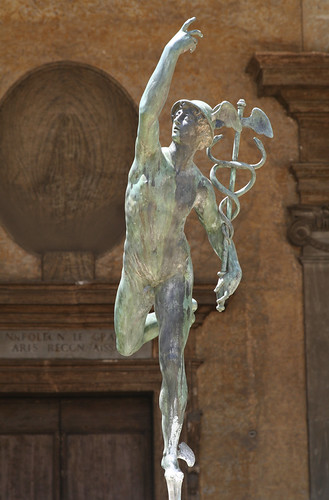
Mercury is posed on a severed head, thing I did not notice at first because I had been somewhat distracted...
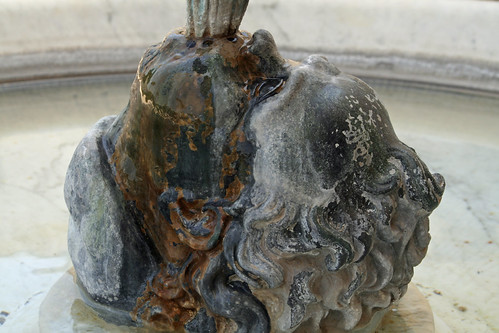
If you see what I mean...
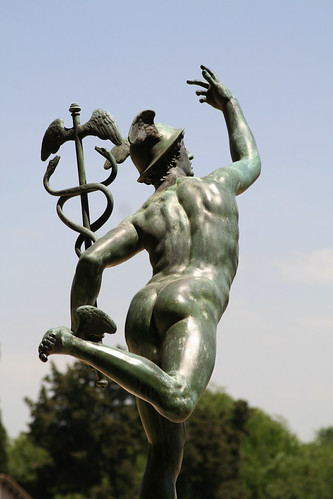
Ah. Hem. Have I mentioned there were lions?

The courtyard outside the patio includes a strange sculpture left there by one of the boarders. You can see its top behind the griffin.

This is a cast of one tree which had been in the parc of the Castle of Versailles and which had been felled by the tempests of 1988.
The artist then made resin boulders to decorate the rather desolate skeleton.
Another view of the house:
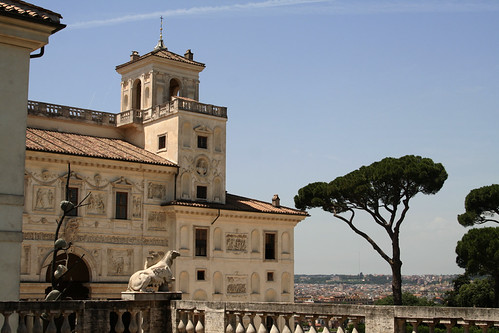
The gardens are dotted with sculptures, the most striking - to me at least - being the group representing the Massacre of Niobe's children.
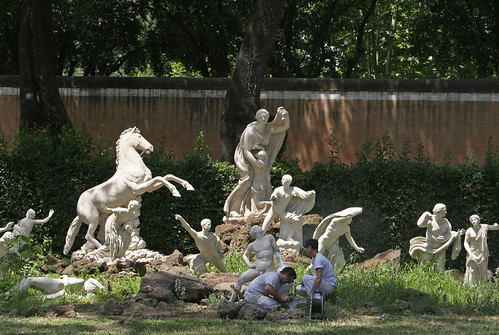
These are plaster casts of the orginal marbles acquired by Cardinal Ferdinando in 1583. The originals are (should be) in Florence.
Because they are just casts, they need constant manutention and that what those two guys in white are doing.
But they are a lovely lot, nevertheless.
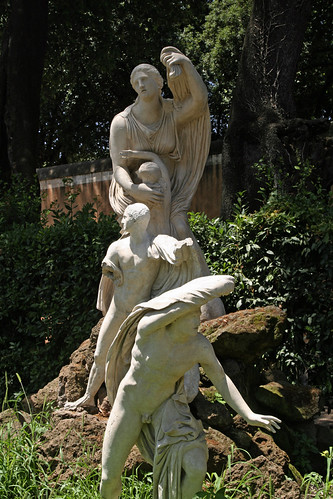
 This lot look like they are doing tai chi
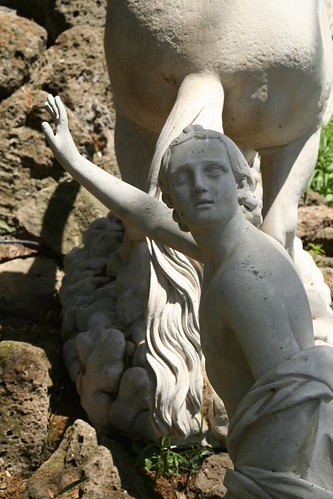
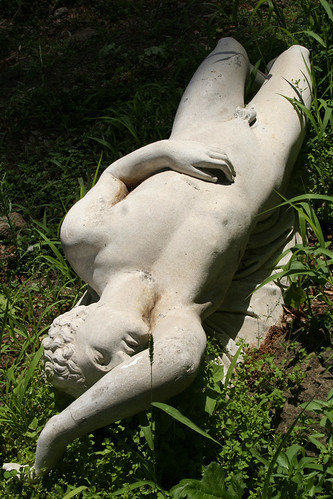 My favourite...
Although this one isn't bad either:
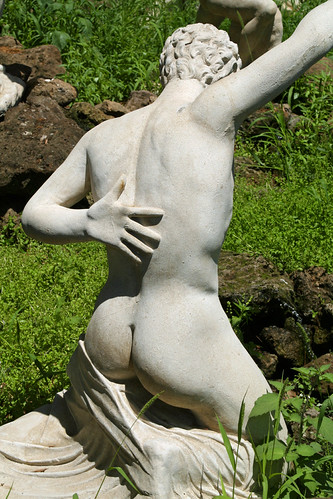
I think I am getting distracted again here...
The garden has a lot of little temples (created so at every alley crossing a visitor might view a statue) such as these two:

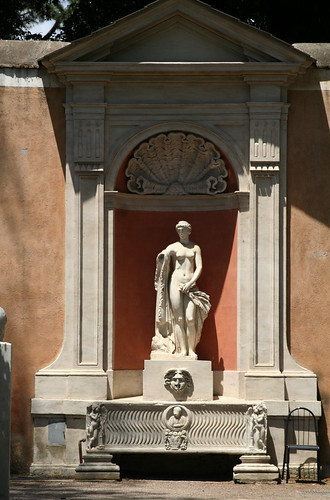
This one with the Venus of Cnyde was pained by Velasquez:

And I am pretty sure that I have seen a reproduction of this in the Musei Capitolini:


You can spot an artist's house in this view:
 Lucky people.
The visit is always with a guide to ensure that they are not disturbed by the public.
In one of the pavilions, frescoes were discovered recently. They are the work of Jacopo Zucchi and represents a pergola housing a multitude of birds and animals some mundane, others recently (recently in 1577) discovered,

The pavillion is currently housing a mirror installation for a summer show and I had load of fun wih that but I won't bore you with ALL the pictures

The adjacent room is also all frescoed with grotesque figures and allegories
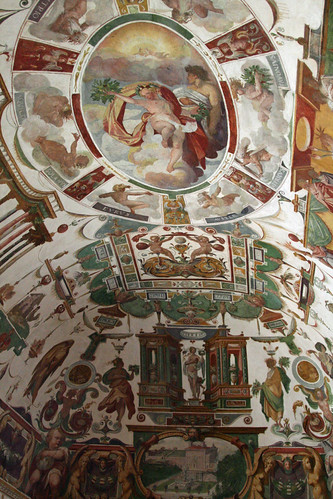
And fables from Aesope (this was BEFORE Jean de Lafontaine rediscovered and revamped them):

Some girl playing with the mirrors...

Back in the Villa, we visited the Grand Salon, which is not terribly impressive but had a nice balcony and a lovely piano:


Afterwards we went into the Gallery Ferdinand de Medicis, where the Library and the cafeteria are located.
This is the view from the bar:

The library is behind those statues.
In view of the vast amount of librarians on my Friends list, I took a sneak peek into the library (it is not open to the public):

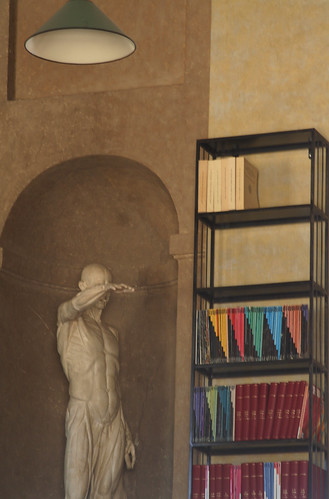
But then the visit was completed and I was hungry, so I decided to have lunch there.
The view was SO nice:
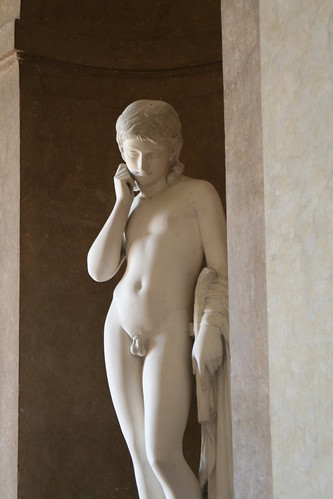
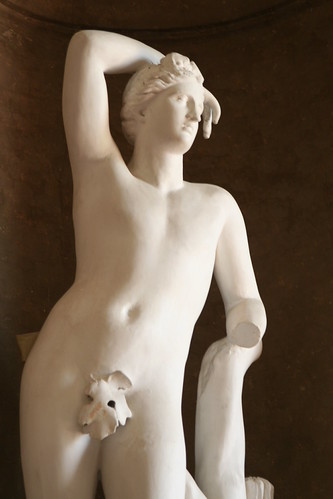
Oh. Hem. Here I go again.
I meant: The VIEW was so nice:

That's the Vittoriano reflected in the central panel, by the way...
As usual, I did not want to put ALL my pictures in there, so you can see more THERE.
Some information about the Academie de France in Rome is also available in French and Italian from their site.
The site is rumoured as being that of the palace of Messalina and where she was murdered.
In the 16th century, the place was acquired by the Medici family, who was the most important family in Florence.
The guy doing the actual acquiring was Cardinal Fernando de' Medici and it must have been useful for him to live nearby the Vatican.
Can you spot the dome of Saint Peter just straight ahead?
Also, the Medici family actually produced three popes so having a pied-à-terre in Rome was handy.
While they did have other buildings in the city, the villa became almost immediately the most famous one. First and foremost was its coin of vantage (with that direct view on the Vatican), but also the architect, Bartolomeo Ammanati, created a beautiful building which was designed to show the mighty power of the Medici family.
Then there was the art. The Medici were wealthy patrons of the arts and also great collectors of the antique Roman bits that were unearthed just about everywhere in and around the city. The palace and its elegant gardens (made to emulate those of the palace in Florence) were like a museum.
The house and its collections fell into the possession of France in 1807 and Napoleon Bonaparte, who loved all things antique, thought it would be a great idea to send a few good artists in Rome to copy all the art that was available there so they could learn and come back home later to reproduce all these splendors on French grounds.
Thus was the Academy de France à Rome born.
Or rather reborn as the Académie had really been created in 1666 by King Louis XVIV (although not located at the Villa) but ,obviously, the traditions had been discontinued after the French revolution.
The boarders were once selected after a very tough competition (the so-called Prix de Rome) and their skills spanned most traditional art disciplines (painting, sculpture, architecture, metal-engraving, precious-stone engraving, musical composition). The competition was formally abandoned in 1968 and selections are now done on applications. Not that this makes the process any easier. It certainly doesn't make it any more transparent.
Nowadays, the subjects of study have been expanded to include new artistic fields (art history, archaeology, literature, stagecraft, photography, movies, video, art restoration, writing and even cooking). Dance seems still to be missing.
Artists are coming to lodge in the villa (or rather small pavilions dotted in the gardens) with their families (what with the competition, they are rarely young things when they finally make it) and their stays vary from six to eighteen months.
The current director of the academie is Frederic Mitterrand (a nephew of President François Miterrand). He is the one who decided to open the Villa to the public. Before that, visits were only possible upon invitation. Visits of the gardens were possible but restricted.
But that's just the blabla. Let's have a look around...
The most impressive part of the villa is the Loggia, which is adorned with various statues - including two Medici lions - and an attractive fountain graced by a statue of Mercury, designed by Giambologna (In French: Jean de Bologne).
Mercury being the god of merchants (and thieves) it was the pagan divinity selected by the Medici to represent them....
Mercury is posed on a severed head, thing I did not notice at first because I had been somewhat distracted...
If you see what I mean...
Ah. Hem. Have I mentioned there were lions?
The courtyard outside the patio includes a strange sculpture left there by one of the boarders. You can see its top behind the griffin.
This is a cast of one tree which had been in the parc of the Castle of Versailles and which had been felled by the tempests of 1988.
The artist then made resin boulders to decorate the rather desolate skeleton.
Another view of the house:
The gardens are dotted with sculptures, the most striking - to me at least - being the group representing the Massacre of Niobe's children.
These are plaster casts of the orginal marbles acquired by Cardinal Ferdinando in 1583. The originals are (should be) in Florence.
Because they are just casts, they need constant manutention and that what those two guys in white are doing.
But they are a lovely lot, nevertheless.
This lot look like they are doing tai chi My favourite...Although this one isn't bad either:
I think I am getting distracted again here...
The garden has a lot of little temples (created so at every alley crossing a visitor might view a statue) such as these two:
This one with the Venus of Cnyde was pained by Velasquez:
And I am pretty sure that I have seen a reproduction of this in the Musei Capitolini:
You can spot an artist's house in this view:
Lucky people.The visit is always with a guide to ensure that they are not disturbed by the public.
In one of the pavilions, frescoes were discovered recently. They are the work of Jacopo Zucchi and represents a pergola housing a multitude of birds and animals some mundane, others recently (recently in 1577) discovered,
The pavillion is currently housing a mirror installation for a summer show and I had load of fun wih that but I won't bore you with ALL the pictures
The adjacent room is also all frescoed with grotesque figures and allegories
And fables from Aesope (this was BEFORE Jean de Lafontaine rediscovered and revamped them):
Some girl playing with the mirrors...
Back in the Villa, we visited the Grand Salon, which is not terribly impressive but had a nice balcony and a lovely piano:
Afterwards we went into the Gallery Ferdinand de Medicis, where the Library and the cafeteria are located.
This is the view from the bar:
The library is behind those statues.
In view of the vast amount of librarians on my Friends list, I took a sneak peek into the library (it is not open to the public):
But then the visit was completed and I was hungry, so I decided to have lunch there.
The view was SO nice:
Oh. Hem. Here I go again.
I meant: The VIEW was so nice:
That's the Vittoriano reflected in the central panel, by the way...
As usual, I did not want to put ALL my pictures in there, so you can see more THERE.
Some information about the Academie de France in Rome is also available in French and Italian from their site.
Tags: