![[personal profile]](https://www.dreamwidth.org/img/silk/identity/user.png)
Yesterday there was some blistering heat, so i thought it would be the best time to go about the city centre...
Actually although the temperature was around 40 C, I had elected to go to San paolo fuori le Mura and to go and try if I could - after all these years - get inside the Vatican museums, reckoning that the church would be cool and the museums air conditioned.
So first stop was the basilica of San Paolo fuori le Mura (Saint Paul Ouside the Walls), thus called because it was built way outside the perimeter of the city walls, Really, at the time, it must have been built in the middle of nowhere...
Its construction started at the end of the 4th century on the site where the grave of Saint Paul was said to be.
The grave is still there to be seen inside the church:

Saint Paul, thus.
Paul of Tarsus (a city in Turkey, not very far from Antioch) was one of the earliest Christian missionaries. He is shown wielding a huge sword so I thought he was the Roman soldier of the lot but Cesare, who had to attend catechism as a child tells me he is not (the soldier one being Simon) although, as a Pharisee, he was known to persecute the early Christian disciples before his conversion.
This conversion is said to have happened around 33 AD. After that he moved about quite a bit, spreading the word, until his last stay in Jerusalem in 57, where he was arrested, then tried and sentenced to prison,
After two years, he appealed to Caesar of the prison sentence as a Roman citizen and was sent to Rome for a re-trial. it was two more years before he finally could get the judgment and his choice of a lawyer must have been rather disastrous because he was sentenced to be beheaded.
Ooops.
Mind you, a lot of people thought he was responsible for bringing that new fangled exotic religion that made slaves the equals of their masters into Rome itself and so of course he could not be allowed to live. So off with his head, said the magistrates. Nero was emperor (death is placed anywhere between 62 and 67 AD).
Right. Lets have a look at the guy:

The construction of the church began in the late 4th century, being supplemented along the centuries to become a huge thing by the 13th, with a cloister being added between 1220 and 1241.

The cloister remains as it was built but the church was almost completely destroyed by a fire in 1823. The church was reopened in 1840 and loads of sovereign contributed precious materials for its reconstruction (alabaster from Egypt, malachite and lapis stones for the altars from Russia) but in 1891, a nearby explosion at Porta Portese blew all the stained glass windows.
Since then, they have been replaced by sheets of stone:

Some of the original mosaics were restored

This canopy is by Arnolfo di Cambio and, although it is a fine piece, in its gothic style seems a little out of place in that church...

What with the mosaics making the Byzantium influence of the church very clear (and fitting, since Paul was from Turkey).
The building is enormous (one nave and four aisles, 131.66 m-long, 65 m-wide and 29.70 m-high) and was mostly empty except for a few rows of benches, which became populated by a crowd of stealth priests while we were there. They came in as a tourist group, with back packs and suddenly did a reverse strip and donned their fineries before sitting down to a ad hoc mass (liturgical flash mob?):

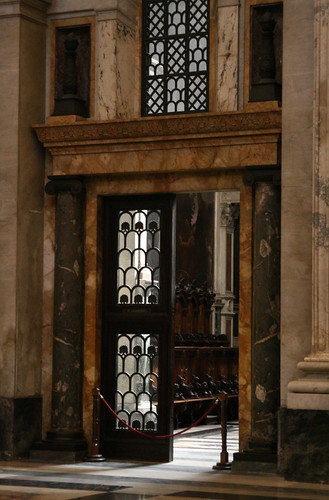
The basilica has few interesting chapels, one one which with nice ornate wooden pews:

One of its most interesting features is a huge paschal candlestick in the right-hand transept, standing more than 5 metres high, by Nichola dell'Angelo and Pietro Vassalletto. It was made in the 12th century And far better suited to the original style of the church than the canopy.
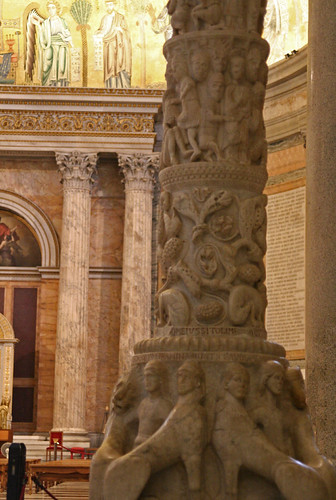

Besides the scenes of the passion, it also has strange grotesque figures:


Another fine piece I found is a baptismal fount sporting a cowering devil as its base:

This looks like a more recent piece than 13th century but I could not find any information on it.

The monumental entrance of the basilica is graced by a portico boasting of 150 columns, mosaics and few statues.
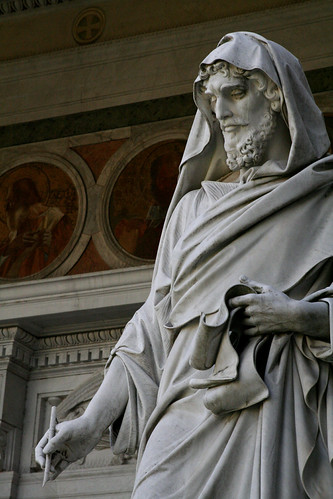


This stiff angel is a clear sign that this part has been rebuilt in the 19th century.
The nicest part of the church is not the church at all but its cloister (also because it is authentic):

It is rumoured to be one of the prettiest of Rome.

Since the church was built on the site of a graveyard, a lot of antique funerary art is embedded on the walls, coming from coffins and lapidaries:


Some of the columns are supporting scenes in between them:


Look! Adam and Eve! (after the apple feast: they are already covering themselves up):

That's all for San Paolo.
Next stop: The Vatican Museums.
Actually although the temperature was around 40 C, I had elected to go to San paolo fuori le Mura and to go and try if I could - after all these years - get inside the Vatican museums, reckoning that the church would be cool and the museums air conditioned.
So first stop was the basilica of San Paolo fuori le Mura (Saint Paul Ouside the Walls), thus called because it was built way outside the perimeter of the city walls, Really, at the time, it must have been built in the middle of nowhere...
Its construction started at the end of the 4th century on the site where the grave of Saint Paul was said to be.
The grave is still there to be seen inside the church:
Saint Paul, thus.
Paul of Tarsus (a city in Turkey, not very far from Antioch) was one of the earliest Christian missionaries. He is shown wielding a huge sword so I thought he was the Roman soldier of the lot but Cesare, who had to attend catechism as a child tells me he is not (the soldier one being Simon) although, as a Pharisee, he was known to persecute the early Christian disciples before his conversion.
This conversion is said to have happened around 33 AD. After that he moved about quite a bit, spreading the word, until his last stay in Jerusalem in 57, where he was arrested, then tried and sentenced to prison,
After two years, he appealed to Caesar of the prison sentence as a Roman citizen and was sent to Rome for a re-trial. it was two more years before he finally could get the judgment and his choice of a lawyer must have been rather disastrous because he was sentenced to be beheaded.
Ooops.
Mind you, a lot of people thought he was responsible for bringing that new fangled exotic religion that made slaves the equals of their masters into Rome itself and so of course he could not be allowed to live. So off with his head, said the magistrates. Nero was emperor (death is placed anywhere between 62 and 67 AD).
Right. Lets have a look at the guy:
The construction of the church began in the late 4th century, being supplemented along the centuries to become a huge thing by the 13th, with a cloister being added between 1220 and 1241.
The cloister remains as it was built but the church was almost completely destroyed by a fire in 1823. The church was reopened in 1840 and loads of sovereign contributed precious materials for its reconstruction (alabaster from Egypt, malachite and lapis stones for the altars from Russia) but in 1891, a nearby explosion at Porta Portese blew all the stained glass windows.
Since then, they have been replaced by sheets of stone:
Some of the original mosaics were restored
This canopy is by Arnolfo di Cambio and, although it is a fine piece, in its gothic style seems a little out of place in that church...
What with the mosaics making the Byzantium influence of the church very clear (and fitting, since Paul was from Turkey).
The building is enormous (one nave and four aisles, 131.66 m-long, 65 m-wide and 29.70 m-high) and was mostly empty except for a few rows of benches, which became populated by a crowd of stealth priests while we were there. They came in as a tourist group, with back packs and suddenly did a reverse strip and donned their fineries before sitting down to a ad hoc mass (liturgical flash mob?):
The basilica has few interesting chapels, one one which with nice ornate wooden pews:
One of its most interesting features is a huge paschal candlestick in the right-hand transept, standing more than 5 metres high, by Nichola dell'Angelo and Pietro Vassalletto. It was made in the 12th century And far better suited to the original style of the church than the canopy.
Besides the scenes of the passion, it also has strange grotesque figures:
Another fine piece I found is a baptismal fount sporting a cowering devil as its base:
This looks like a more recent piece than 13th century but I could not find any information on it.
The monumental entrance of the basilica is graced by a portico boasting of 150 columns, mosaics and few statues.
This stiff angel is a clear sign that this part has been rebuilt in the 19th century.
The nicest part of the church is not the church at all but its cloister (also because it is authentic):
It is rumoured to be one of the prettiest of Rome.
Since the church was built on the site of a graveyard, a lot of antique funerary art is embedded on the walls, coming from coffins and lapidaries:
Some of the columns are supporting scenes in between them:
Look! Adam and Eve! (after the apple feast: they are already covering themselves up):
That's all for San Paolo.
Next stop: The Vatican Museums.
Tags: